

Singer d. 2024
Information on the life and music of Rod can be found in the obituaries quoted below.
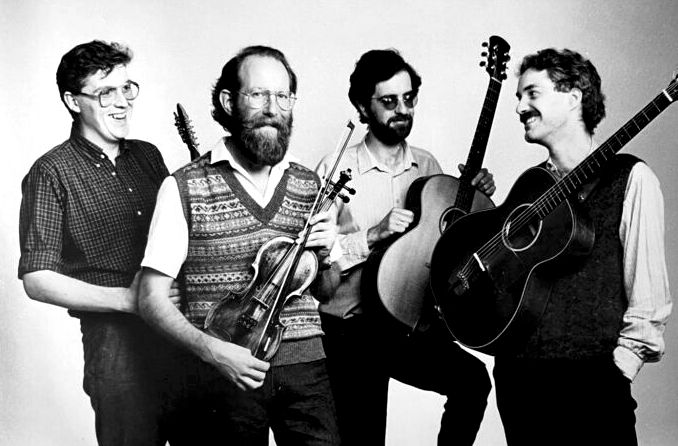
These photographs of Rod we think were taken by Norman Chalmers in the early 1980s. Click on each to enlarge:


The following tracks were recorded at a house concert in Edinburgh by Stuart Eydmann. For more songs from Rod see also Chorda, Easy Club and Jock Tamson’s Bairns.
Hamlet
Hermless
Now westlin winds and slaught’ring guns
Old Town Shuffle
Presence
Rigs o Rye
Roll that boulder away
Twa witty wives
Walkin’ my baby back home
We’re a’ noddin
Willie Wastle
The following track was recorded live at the final recital by percussionist Jenny Hoy of Edinburgh:
Wantonness
Rod sings a song by Robert Burns with marimba accompaniment arranged and played by Jenny Hoy.
Obituary by Jim Gilchrist published in The Scotsman 10th Jun 2024
Rod Paterson, traditional singer and musician. Born: 28 December 1953 in Calcutta, India. Died: 30 May 2024 in Dunkeld, Perthshire, aged 70.
Widely regarded as the finest male Scots traditional singer of his generation, particularly renowned for his Burns interpretations, no mean guitarist and a composer of characterful songs, Rod Paterson’s mellifluous tenor tones were unmistakable, whether singing with such notable bands as Jock Tamson’s Bairns, the Easy Club and Ceolbeg, or as a solo performer.
He could also, however, give supple voice to the Great American songbook – witness his 1987 album with saxophonist Dick Lee, Two Hats, on which traditional gems such as The Bleacher Lass o Kelvinhaugh rubbed tuneful shoulders with My Funny Valentine.
Many of his own compositions were songs of worth, from the picaresque Auld Toon Shuffle with its “hot club” accompaniment from the Easy Club, to the dreamy languor of India, a tribute to his birthplace.
For Rod was a “jute bairn”, born in Calcutta where his father, William Paterson, worked, like so many other Dundonians, as a clerk in a jute mill. His mother, Mary Robertson, was also from Dundee. His grandfather’s brother, Ernest Robertson, owned Robertson’s lemonade factory in Dundee and Rod was proud to say that Ernest had also been a chairman of Dundee United.
Rod returned to Scotland at the age of six months, family settling in Birkhill, Angus, just outside Dundee. He was educated at Muirhead Primary then Dundee High School, then studied Spanish and philosophy at Edinburgh University where he managed, despite much time spent in the nearby folk haven of Sandy Bell’s bar, to gain a philosophy degree. He was praised for his Spanish during frequent visits to Spain with his partner, Catriona, although he was also told it was correct to the point of being old-fashioned – “sounding like Cervantes”, as one Spanish acquaintance told him.
Rod had taken up guitar as an adolescent, admiring the style of such players as Rab Noakes, John Renbourn and Bert Jansch, and at 16 played his first gig in Dundee’s Woodlands Hotel (where he first encountered the Dundee bard, Michael Marra, with whom he became a good friend and collaborator). While at university, amid the Sandy Bell’s session hotbed, he met up with John Croall, Norman Chalmers, and Peter McClements, who went on in the mid-Seventies to form the band Chorda, playing Europe with a variable line-up.
With Croall and Chalmers (both of whom have also, sadly, recently passed away), guitarist Jack Evans, fellow-singer Tony Cuffe and fiddlers Adam Jack and Ian Hardie, Paterson would form Jock Tamson’s Bairns, a band whose distinctive and keenly committed approach to Scottish traditional music and song (at a time when Irish music was near-ubiquitous) would bring them legendary status, from the late Seventies until the turn of the Millennium, despite a two-decade hiatus.
During that gap, Rod joined another highly influential band to emerge from the Sandy Bell’s crucible, the powerful “Scots swing” of The Easy Club.
It was perhaps a moment on the Bairns’ first album, however, that brought home the expressive power of his voice, the band breaking off for him to launch into a memorably poignant, initially unaccompanied rendition of Robert Burns’s confessional Wantonness.
His delivery of “muckle sangs” such as Clarke Saunders or Earl Richard demonstrated his ability to inhabit a song and unfold its tale, but he could also give lightsome voice to ditties such as Kate Dalrymple, Rattlin’ Roarin’ Willie or, with The Easy Club, let rip with Irving Berlin’s Let Yourself Go.
His most recent release was just earlier this year, on unearthed tracks by Bring In the Spirit, a collective also including singer Kirsten Easdale, originally formed for 2009’s 250th anniversary of Robert Burns’s birth.
Along with other Bairns, Rod became involved in musical theatre work, particularly with author and broadcaster Billy Kay’s shows Knee Deep in Claret and Fergusson’s Auld Reekie, the latter celebrating Edinburgh’s tragic “poet of plainstanes and causey”. Performed in Edinburgh’s Bedlam Theatre, on the very site where Fergusson was ultimately incarcerated and died, there was a distinct frisson as Paterson sang the poet’s favourite, the plaintive Birks of Invermay. Rod and fellow Bairns were also enlisted in some of Mike Maran’s Fringe shows, notably The Canty Hole, recreating a companionable 18th-century howff.”
A memorable stage appearance came with The Big Picnic, Bill Bryden’s epic 1994 First World War promenade production at a former shipyard in Govan, when he led the cast in a deeply moving finale rendition of the hymn Only Remembered.
There were appearances on television’s Transatlantic Sessions and occasional film involvement, not least for the 1992 romance Salt On Our Skin, starring Greta Scacchi and Vincent D’Onofrio, Rod attempted unsuccessfully, to tutor D’Onofrio in a song, so ended up providing a voice-over.
He also became a tutor on the Royal Conservatoire of Scotland’s traditional music degree course, the Conservatoire posting online that he “leaves behind a legacy of countless young voices carrying on his songs, his style, his knowledge and wisdom”.
The huge number of tributes on Facebook and elsewhere bear witness to the regard and affection in which he was held. Billy Kay declared: “My country has lost the finest Scots singer of our generation. His was a voice that had the purity of the classic Scots tenors revered by my father, and the clarity of Scots diction inherited by the great traveller tradition bearers like Jeanie Robertson. It was also a voice of soaring beauty and douce human empathy which came from within the man himself.”
Fellow Easy Club member, musician and composer Jim Sutherland recalls meeting in Bell’s “a young and dashing man who would put you in mind of Omar Sharif.
“Rod had a beautiful mind. I loved his quiet drollness too, and his wonderfully puntastic use of Latin phrases. Our Easy Club van was called Gloria, a derivation of ‘sic transit gloria mundi’. It did keep breaking down after all.”
Paterson died at home near Dunkeld, after a struggle with cancer. He is survived by his partner of 36 years, Catriona, his elder brother Renwick, niece Corri and nephew Renwick, and their children.

Obituary by Morag Lindsay published in The Courier, 9 June 2024
Rod Paterson tributes paid as Dundee and Perthshire folk music legend dies
Rod has been described as ‘the finest Scots singer of our generation’.
Rod Paterson, who has died at his home near Dunkeld aged 70, was an influential figure on the Scottish traditional music scene.
He was in the vanguard of the folk revival in the 1970s – a talented guitarist with an unforgettable voice, whose interpretation of the songs of Robert Burns was unparalleled.
A contemporary and great pal of legends such as the late Michael Marra, Rod was influenced by musicians such as Rab Noakes and John Renbourn and performed in a number of bands over the years, as well as in stage productions.
He was also a respected tutor of Scots song at the Royal Conservatoire of Scotland.
And tributes have poured in from former students – many of whom have gone on to achieve great things – as well as from fans and his many friends.
Rod grew up in Dundee and lived in Perthshire for many years. But he was born in Calcutta – “a jute baby”.
His mother Mary sailed out from Dundee to marry William Paterson, who was working in the jute industry there. And Rod wrote a song called India many years later celebrating the links between the two jute capitals.
Jute was not his only tie to the fabric of Dundee. His great-uncle Ernest Robertson was a former chairman of Dundee United – Rod’s football team – and owner of the famous Robertson’s lemonade factory in Dundee.
The family returned to Scotland, settling at Birkhill, in Angus, and Rod and brother Renwick continued their education.
Rod went to Muirhead Primary School, then the High School of Dundee.
It was around this time he also started learning to play the guitar.
His great pal Michael Marra – “the bard of Lochee” – used to rib him about their contrasting schools, calling him “Lord Snooty” after the Beano character.
This was typical of the pair’s friendship.
Rod went on to Edinburgh University, where he studied philosophy…
The Edinburgh session pub was at the heart of Scotland’s folk music scene in the 1960s and 70s – and Rod threw himself into it with gusto.
It was there he met legends like Hamish Henderson. He was also influenced by the Irish folk bands of the time, such as Planxty, and a great admirer of the Scottish Traveller and folk singer Jeannie Robertson.
By the time he gained his degree, his future course was set. And it was not in philosophy.
Rod was already working as a professional musician, playing guitar and fine-tuning his remarkable singing voice. This would be his career, and he would excel at it.
Long-time friend Billy Kay worked with him on many projects.
He said Rod was “the finest Scots singer of our generation”.
“His was a voice that had the purity of the classic Scots tenors and the clarity of Scots diction inherited by the great traveller tradition bearers like Jeannie Robertson,” said Billy.
“I once said that I would be happy appearing before an audience and reading extracts from the Telephone Directory as long as I knew that Rod would come in in every five minutes with one of his songs,” he added.
“That would be enough to take the audience with us.”
Rod played in a number of groups, including Chorda, Jock Tamson’s Bairns, The Easy Club, who merged folk with more of a jazz/swing style, and Bring In the Spirit with whom he made his final recording earlier this year.
He also performed in landmark Scottish stage shows, such as Communicado’s production of Jock Tamson’s Bairns at the Tramway in Glasgow and The Ship and The Big Picnic at the Harland and Wolff shipyard.
Rod also taught at the Royal Conservatoire of Scotland for many years, inspiring many of the current generation of traditional musicians.
Writing on Instagram, former student Iona Fyfe described him as “an absolute legend of a man and font of knowledge”.
“Rod generously and unreservedly shared with me so many wonderful songs, anecdotes and stories,” she said.
“His passion was infectious.
“If it wasn’t for Rod’s grandfatherly guidance, unwavering support and songs, I’d have dropped out of my music degree in the first six months.
“We’ve lost one of our best.”
 rareTunes